Recently at the field I was shown a couple of battery packs that were used as flight packs for a large model that had suffered from a short. The setup was two packs with an electronic change over switch to select the pack with the highest voltage to power the receiver and servos. In this instance when one pack failed the second pack powered the receiver and servos. Fortunately this was the only damage that occurred. If this was the only pack powering the plane the damage would have been significantly more resulting in the loss of the aircraft and possible property damage.
The probable cause was initially a short between two of the battery cases that led to intense heat and the damage you can see. In series connected batteries there is the cell voltage between two adjacent cell cases, in this case 1.5 volts. The pack is rated at 6 volts and 2000 mAh and under the correct load will supply 2 amps at 6 volts for an hour. However in the case of a short circuit between two cells when the insulating material between the cells breaks down it is not the voltage (1.5 volts) but the current the cell can deliver that causes problems, in this case significantly more that 2 amps. In theory using Ohms law (current = voltage divided by resistance) the current is infinite as there is no resistance between the cell cases, in practice the current is limited to what the battery can supply and is determined by the internal resistance of the cell. For an explanation on battery internal resistance see https://data.energizer.com/pdfs/batteryir.pdf. Using the typical values quoted in the article of 300 down to 150 milliohms, the current would be in the range of 5 to 10 amps. This would generate a significant amount of heat causing the plastic covering on the batteries to melt resulting in further cells shorting together. This caused the pack to be destroyed and damage to the aircraft.
The message here is to treat you flight packs with care and respect. Periodically inspect packs for integrity and change any pack that has sustained damage particularly to the cell covering.
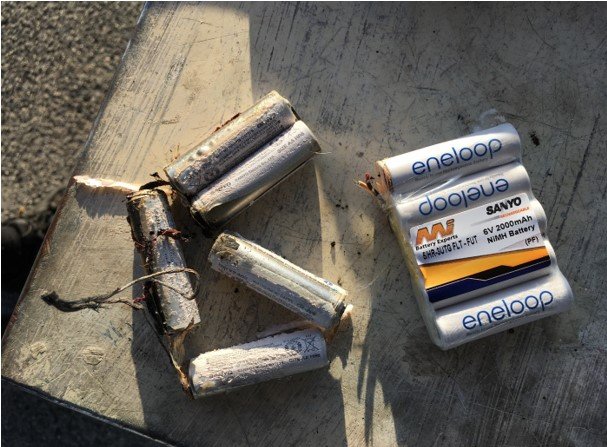
Burnt Out Batteries